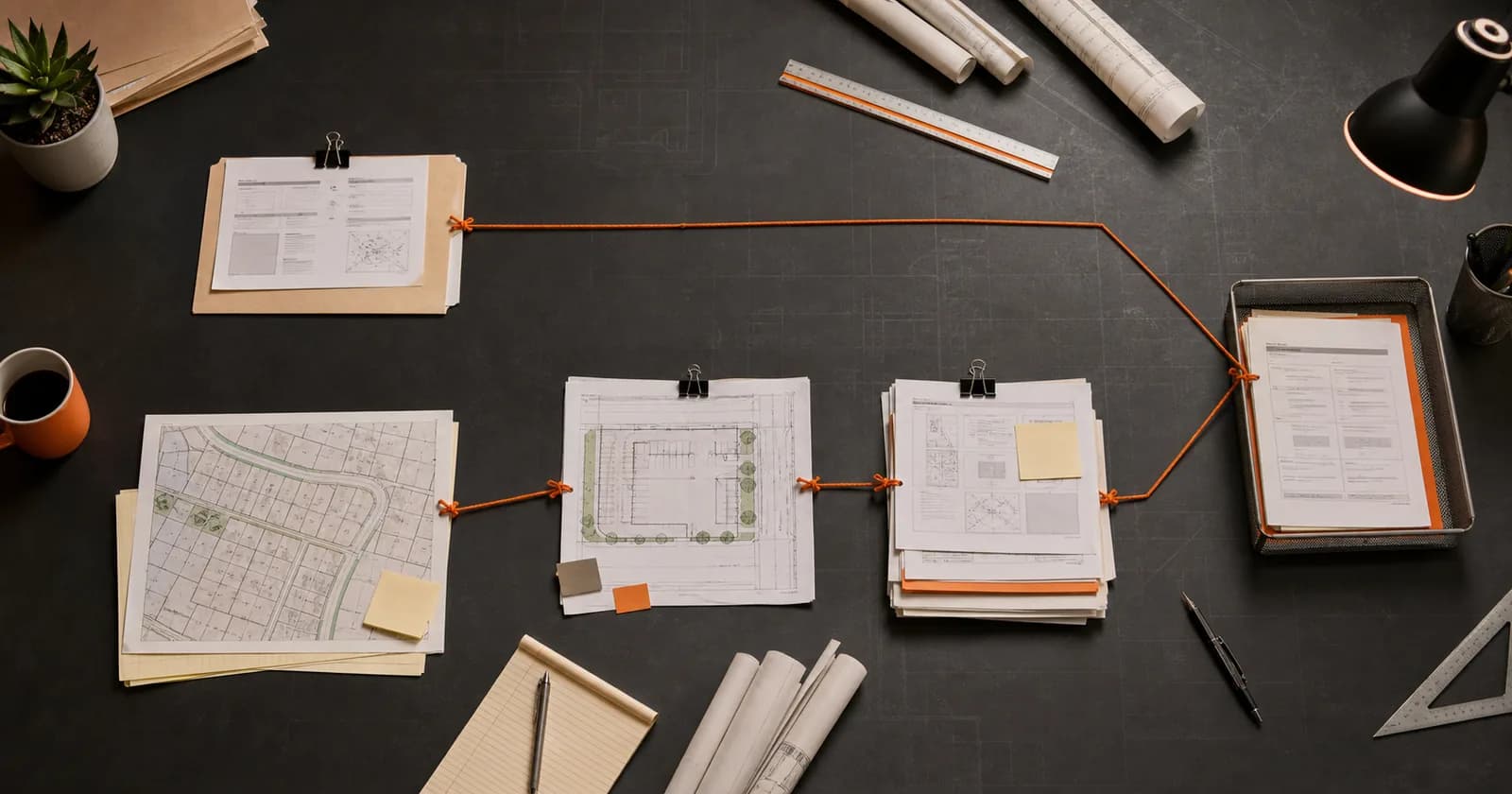
A deck builder running four crews files through the portal on a Tuesday morning. The deposit is collected, the lumber is on a will-call hold, and the homeowner has already told the neighbors about the graduation party. Eleven days later the email lands. Application incomplete. The owner authorization page came through without a signature.
Fixing it takes ninety seconds. Print the page, get the signature, scan, upload.
What happens next is the part nobody puts on the schedule. The corrected packet does not drop back into the reviewer's stack where it left off. It starts a new review cycle, and that cycle queues behind the work already in front of it. The signature cost ninety seconds. The place in line cost another full cycle.
That mechanic explains why permit delays wreck a build season out of all proportion to the mistakes that cause them. The department is not ignoring you. It is working a queue, and an incomplete packet is not a paused file. It is a file that comes back around as a new arrival.
Two desks, two different jobsTwo desks, two different jobs
Most building departments split the work into two functions, even when the same person handles both.
| How they differ | Intake screening | Substantive review |
|---|---|---|
| The question asked | Is this reviewable? | Does the work comply? |
| Who handles it | A permit technician | Zoning and building staff |
| What gets checked | Signatures, fee against valuation, local contractor registration, every drawing on the submittal checklist | The proposed work against the ordinance, plus framing, spans, footings, and code compliance |
| How long it takes | Minutes | Days or weeks |
Intake does not care whether your deck meets the rear yard requirement, only whether a reviewer can open the file and work without emailing you first. A building permit and a zoning approval are frequently two separate reviews inside one application, which is why a single omission can stall three desks at once.
That gap is where the money goes. Screening itself takes minutes. Getting screened is the variable. At a counter you find out before you reach your truck. Through a portal your packet waits its turn to be screened, and an unsigned line can sit unread for a week or more. Either way, an omission caught in review costs the whole cycle on top of that.
Why a resubmittal starts a new cycleWhy a resubmittal starts a new cycle
Review queues are worked by the date of the current submittal. Your permit number does not change, and the resubmittal attaches to the same record the department already opened. What restarts is the review. The corrected packet is sorted by when the correction arrived, not by when the project first came in.
Batching makes it worse. Plenty of jurisdictions do not review continuously. They hold a plan review meeting on a set day, or a zoning administrator blocks out certain mornings, or a part-time building official is on site twice a week. Miss one of those sessions and you are not waiting a day. You wait for the next one, plus whatever piled up in between.
Routing adds a third layer. If your application touched zoning, building, and engineering the first time, a resubmittal often goes back to all three even when only one wrote a comment, and your file waits in each of those queues again.
None of this is punitive. It is how a queue behaves when the sort key is the date the current submittal landed.
The four omissions that do the most damageThe four omissions that do the most damage
Rejections cluster. Two of these die at the counter and two survive intake only to come back as zoning comments weeks later, which is what makes them expensive.
| Omission | Where it stops the packet | What clears it |
|---|---|---|
| Owner authorization unsigned or signed by the wrong person | Intake, before review starts | A signature from the person or entity on the deed |
| Contractor not registered in that jurisdiction | Intake, before review starts | Local registration, often a certificate of insurance naming the municipality and a current renewal |
| Site plan carrying no dimensions | Zoning comments, weeks later | Dimensions to every lot line, drawn over a current plat of survey |
| Scope line contradicting the drawings | Zoning comments, weeks later | A form and sheets that agree on the work and the dimensions |
Stopped at the counter: an owner authorization nobody signedStopped at the counter: an owner authorization nobody signed
When a contractor pulls a permit on a property they do not own, the department wants written proof the owner agreed to it. The form is simple, which is exactly why it gets treated as an afterthought and handed over blank, undated, or signed by the wrong person.
The wrong person is the common version. A spouse who is not on the deed, an adult child managing a parent's project, a manager signing for an LLC. Title control is what the reviewer verifies, so if the property sits in a trust or a company, ask what proof of signing authority they want.
Stopped at the counter: a contractor registration the jurisdiction has no record ofStopped at the counter: a contractor registration the jurisdiction has no record of
A state license and a local registration are different things. A tradesperson can be perfectly legal statewide and still be unregistered in the village where the job sits. Local registration across Illinois and its neighbors often requires a certificate of insurance naming the municipality, sometimes a bond, and frequently an annual renewal that quietly lapsed in January.
Intake checks this against their own list, not your license card. If you are not on the list, the packet stops there no matter how good the plans are.
Surfaces in review: a site plan without numbers on itSurfaces in review: a site plan without numbers on it
This is the expensive one, and it is expensive because screening cannot catch it. A screener confirms a site plan is attached. Whether the drawing carries a dimension to the side lot line is review work.
A drawing that shows a deck sitting behind a house is a picture. A site plan is a scaled drawing with dimensions from the proposed work to every lot line, plus existing structures, easements, and a north arrow. Without those numbers no reviewer can verify a setback, and none will estimate one for you.
Draw on top of a current plat of survey rather than from memory or a county parcel viewer. Property lines from an aerial map are approximations, and approximations produce the corrections described in setbacks explained without the jargon.
Surfaces in review: a scope line that contradicts the drawingsSurfaces in review: a scope line that contradicts the drawings
The application says "replace deck boards." The drawings show new footings, a wider footprint, and a stair relocation. Both pieces are present, so the packet screens clean. Catching the contradiction means reading the form against the sheets, which is review work.
Those are not the same project, and the mismatch does more than confuse a reviewer. Scope determines routing. A like-for-like repair may never reach zoning. A footprint change on a deck permit absolutely will, and it can pull in a review path the applicant never expected.
Dimensions have to agree too. If the form says 12 by 16 and the plan scales to 12 by 20, somebody has to resolve it. That resolution is a comment, and a comment is a cycle.
What complete looks like before you hit submitWhat complete looks like before you hit submit
- Owner authorization signed and dated by the person or entity on the deed
- Contractor registration active with that jurisdiction, not only the state license
- Site plan to scale with dimensions from the proposed work to every lot line
- Easements, right-of-way lines, and existing structures shown rather than implied
- Scope description matching the drawings in words and dimensions
- Every sheet on the department checklist, labeled with their names
- Fee calculation based on the valuation you wrote on the form
Seven checks take fifteen minutes. Any one missed can cost weeks.
Where the cheap catch livesWhere the cheap catch lives
The version where the slab already got poured is far worse, and it happens every season.
Build the packet for the screener, not the reviewerBuild the packet for the screener, not the reviewer
Whoever decides if your file enters the queue is not evaluating your craftsmanship. They are matching it against a list. Make the match easy.
Assemble documents in the order the department publishes them. Name files using the department's own terms, so a plat of survey is not uploaded as survey_final_v3. Confirm which desks will review before filing, and verify the contractor registration is current in that specific jurisdiction rather than the one next door.
Most of what gets packets rejected is knowable in advance. That is the underlying pattern in why permits get denied and in the rejection triggers that repeat across Illinois, Wisconsin, and Indiana. The rules differ by jurisdiction. The documentation failures do not.
Where a verified requirements set changes the mathWhere a verified requirements set changes the math
Permitech is the permit intelligence ecosystem for construction, built on a plain observation: the expensive part of permitting is rarely the rule, it is learning about the rule too late. AI research pulls a jurisdiction's requirements in about three to five minutes and assembles a full set in roughly half an hour. A human permit technician verifies it, which takes one to four hours depending on how the authority having jurisdiction publishes its material.
That becomes a Permit Package: verified requirements for your address and project type, a Permit Workspace for assembling documents against the actual submittal checklist, and a Permit Application Reference Sheet organizing every answer the department will ask for so you can copy it onto their own form. Coverage runs across 7,000 or more jurisdictions in Illinois, Wisconsin, and Indiana, and the project guides cover what shifts by permit type.
If you would rather hand off the filing, Permit Concierge puts a permit technician on the submittal and the correspondence. Either way the goal is the same. Catch the missing page while it still costs ninety seconds. See what a package runs and weigh it against one lost cycle in July.