It is 4:40 on a Thursday when the portal email lands. The subject line says the application has been returned. The homeowner forwards it to the contractor with three question marks and nothing else, and for an hour nobody opens the attachment, because everyone has already decided what it says.
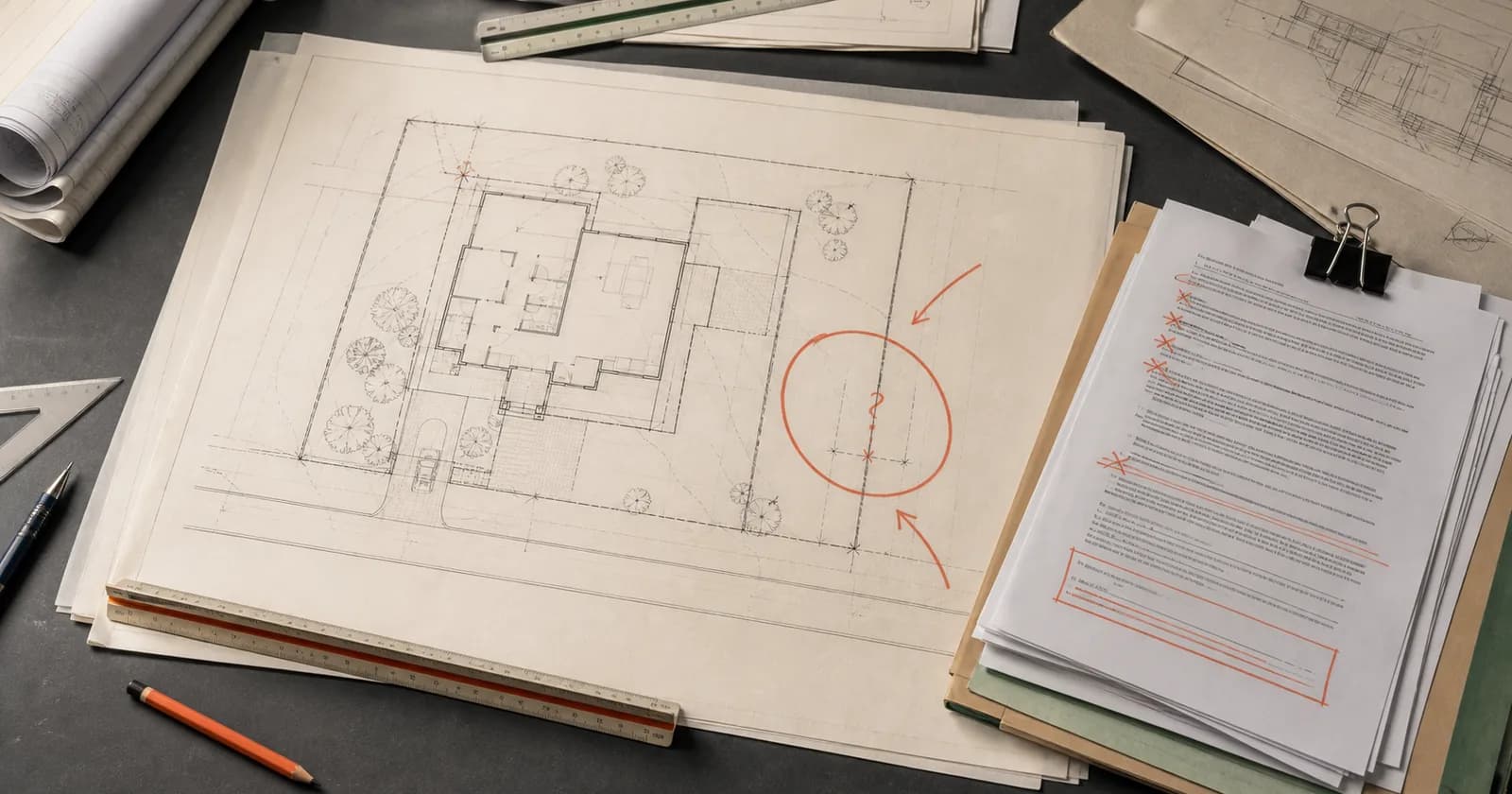
When someone finally reads it, the attachment is a plan review letter with four comments. Two are one-line fixes. One asks for a dimension that was on the drawing all along, hidden under the title block. The fourth is real and takes a call to a surveyor. Nothing was rejected. The reviewer ran out of information and stopped.
That gap, between what people assume happened and what actually happened, is where most permit delay lives. True denials are uncommon. Returns are routine. And most have nothing to do with whether the work meets code.
Denial and correction notice are two different lettersDenial and correction notice are two different letters
Three outcomes get called a denial in normal conversation, and they behave nothing alike.
A correction notice means a reviewer read the submittal and wrote down what has to change. Departments call it review comments, a correction letter, or a markup set. The file stays open, you answer each comment in writing with revised documents, and the project moves. This is the common one, and it rejects nothing.
The word denial belongs to a different outcome: the project cannot be approved as designed. That is almost always a zoning conclusion. The structure exceeds lot coverage, sits inside a required yard, or the use is not allowed in that district. The path forward is a redesign, a variance, or an appeal, and cleaner paperwork does not change it. Anyone unsure which review they are in should sort out how zoning approval differs from a building permit.
What the reviewer is actually doingWhat the reviewer is actually doing
A plan reviewer is not hunting for violations. They are answering three questions using only the documents in front of them, and they write a comment the moment one cannot be answered.
Where is the work. What is the work. Who is doing the work.
A stamped survey and a site plan carrying real dimensions settle where. Drawings and an application that say the same thing settle what. For who, the reviewer looks at signatures, license numbers, and local registrations. A packet that settles all three gets reviewed on its merits even when the project is unusual. One that leaves any of them ambiguous gets returned even when the project is ordinary.
Reviewers approve packets they can read. That is most of it.
The five misses that come back most oftenThe five misses that come back most often
These show up everywhere, in roughly this order.
| What comes back | Why the reviewer stops | What clears it |
|---|---|---|
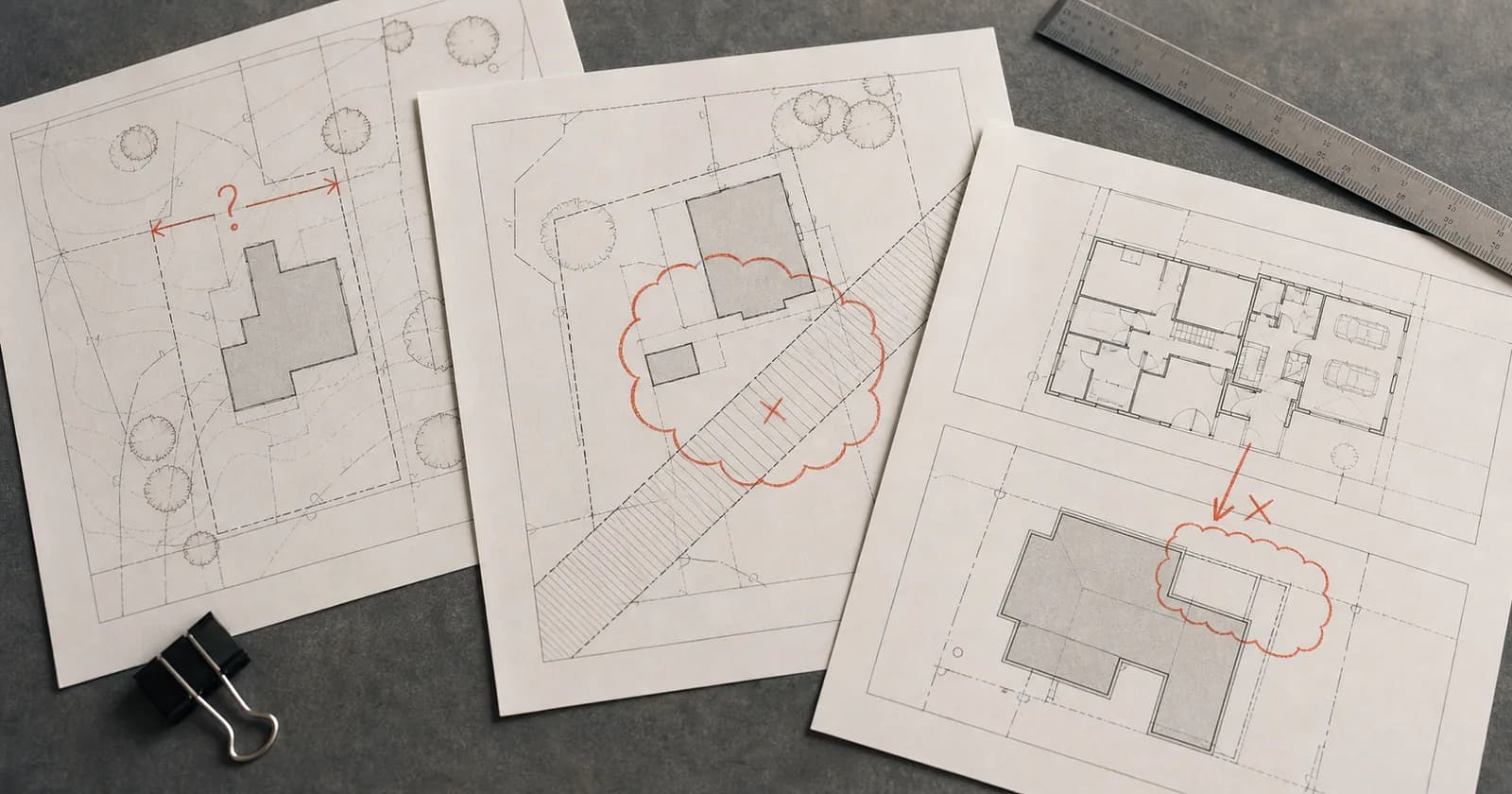
| No plat of survey, or one drawn before a fence, addition, or lot split | No survey means no legal property lines. An outdated one means existing conditions are missing, so setbacks and lot coverage cannot be checked against what is really on the lot | A stamped survey as the base sheet, with existing conditions and the proposed work drawn on it |
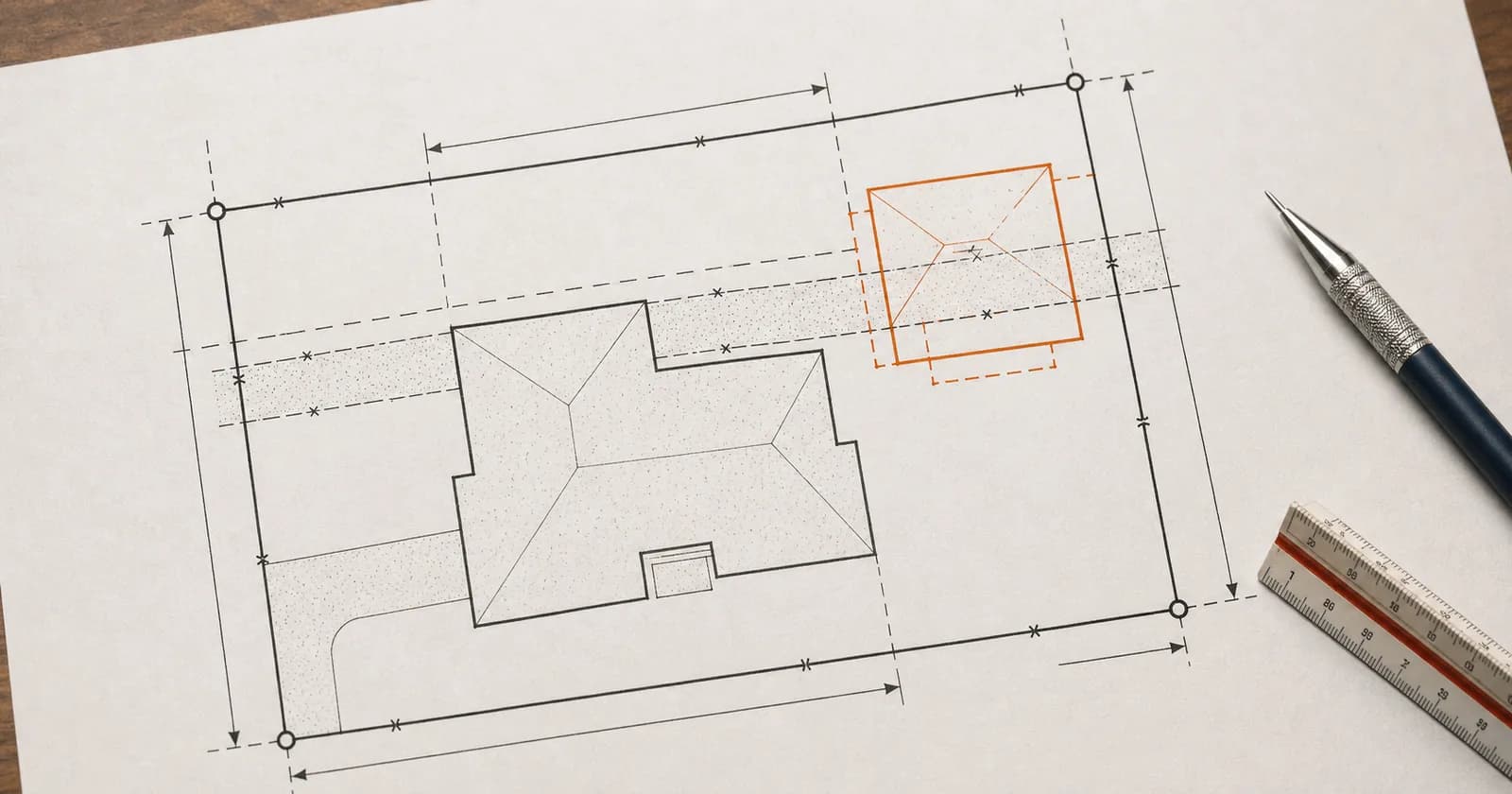
| Setbacks unlabeled, or dimensioned to the curb | No way to confirm the structure sits inside the buildable area | Perpendicular dimensions from each property line to the structure |
| Application scope and drawings disagree | Two different projects in one file | One scope sentence matching application, cover sheet, and notes |
| Missing signature or license number | The file is legally incomplete | Every signature line filled, current license and registration numbers |
| Easement, floodplain, septic field, or well not shown | The work may land on something protected | Recorded easements and mapped conditions drawn on the site plan |
That last row ambushes people most. A recorded easement does not always appear on an older survey, and the utility holding it has rights to that ground regardless of what your copy shows. A floodplain designation pulls in a separate review track with its own forms and reviewer.
Setbacks are what people measure wrong with total confidence. They run from the property line, and that line is frequently not the fence, not the curb, and not where the mowed grass stops. A parkway strip can put it several feet inside where a homeowner believes the yard begins. If that is news, read setbacks in plain language and why reviewers insist on a stamped survey first.
Trade work has its own version: in most towns a building application does not carry the electrical permit, and the licensed trade pulls its own. And deck projects collect every miss on this list, because scope grows between the handshake and the drawing.
My own files say the same thing. Across more than 220 building permits I submitted as a permit technician and can still account for, 37 closed as cancelled. Cancelled is not a synonym for denied, and the spread is the useful part: only some of it was a department saying no.
Why 37 submitted permits were logged as cancelled
More than 220 submitted permits, residential sheds and detached garages. Cancelled covers every file that closed without an issued permit, including customer-side withdrawals.
Source: Permitech analysis of the founder's permit technician case records
Analysis by Permitech
Free to cite with attribution to Permitech and a link to this page. Republishing the chart or the underlying table without attribution is not permitted.
View the data
| Category | Value (cases) |
|---|---|
| Customer self-filed or declined service | 11 |
| Placement problem | 10 |
| Extra permit requirements surfaced | 5 |
| No permit actually required | 4 |
| Customer would not provide a plat of survey | 4 |
| Septic complication | 1 |
| Wrong address | 1 |
| Cancelled after the permit issued | 1 |
Placement and a missing survey account for fourteen of those files between them. Neither is a code failure and neither would have been prevented by reading faster. They are document and measurement problems, caught late, which is the same thing a correction letter is telling you when it arrives.
Why the requirements feel like a moving targetWhy the requirements feel like a moving target
There is rarely one authoritative document. The requirement set for a given address lives across a fee schedule PDF, a submittal checklist last revised years ago, help text in the permit portal, a counter handout, and an email a staff member sent to somebody else in a different season. Several disagree. The reviewer works from the current internal standard, which may be none of them.
Geography multiplies it. Two villages sharing a border can want different things for the same 12 by 16 deck. One wants paper sets, the other a PDF upload. One counts an uncovered deck toward lot coverage and the other does not. Neither is being difficult. Each is internally consistent and externally unpredictable, across the 7,000-plus jurisdictions issuing residential permits in Illinois, Wisconsin, and Indiana.
Which is why an applicant who did everything right in one town feels ambushed in the next. Same applicant, same drawings, different village, different answer.
What a reviewable packet looks likeWhat a reviewable packet looks like
Reviewability is a checklist problem, which makes it solvable. Every item below exists because its absence is a comment somebody got.
- A current plat of survey, stamped by a licensed surveyor, used as the base sheet
- Proposed work drawn on that survey, with a stated scale and a north arrow
- Perpendicular setback dimensions from every property line to the nearest point of the structure
- Recorded easements, utility runs, septic fields, and wells shown
- One scope description reading identically on the application, cover sheet, and drawing notes
- Details answering footing size, frost depth, span, and attachment
- Every signature line filled, with current license and municipal registration numbers
- Lot coverage or impervious surface shown as arithmetic, not asserted
Two habits do most of the work. Draw the structure on the survey rather than beside it, and write the scope once. If it changes after the sale, update the application, the cover sheet, and the notes that same afternoon.
When the miss is in the ground instead of on the paperWhen the miss is in the ground instead of on the paper
Everything above costs time. A smaller category costs money that never comes back, which is why permit technicians get insistent about surveys and easements before ground breaks.
It is also the honest answer to skipping the permit and sorting it out later. Work built without a permit does not become legal by aging. It becomes a disclosure problem at closing, corrected on the department's terms.
Resubmittal is a new trip through the queueResubmittal is a new trip through the queue
Most people assume a resubmittal picks up where the last review stopped. It usually does not. The revised set re-enters the queue, often behind whatever arrived that week, and the reviewer opens it cold. In spring, when every deck, roof, and addition in the Midwest hits at once, that second cycle can run as long as the first. Some departments add a re-review fee after the second round.
So one missing dimension buys a second trip through that queue, and the crew booked for Monday goes to somebody else's job. The downstream cost of a stalled permit shows up in crew utilization and delayed invoicing long before it shows up as a fee.
Getting the first read to be the only readGetting the first read to be the only read
Permitech is the permit intelligence ecosystem for construction across those 7,000-plus jurisdictions. AI and human permit technicians work the same file. The AI pass pulls requirements for an address and scope in about three to five minutes, and a full set lands in roughly half an hour. A human permit technician then verifies it over one to four hours, because a machine reading a checklist PDF from three revisions ago is exactly the failure mode described above.
What comes out is a Permit Package: the verified requirement set for your address and scope, organized in a Permit Workspace, with a Permit Application Reference Sheet holding the answers a permit application asks for, gathered and organized in one place. You copy those answers onto the municipality's own form, because that form is the only one they accept. To hand the filing off entirely, Permit Concierge runs it.
Plan review still works the way it always has. A reviewer who can settle location, scope, and responsibility on the first read is left reviewing your details instead of hunting for what is missing. Code questions still come back. The administrative reset everyone budgets for does not.