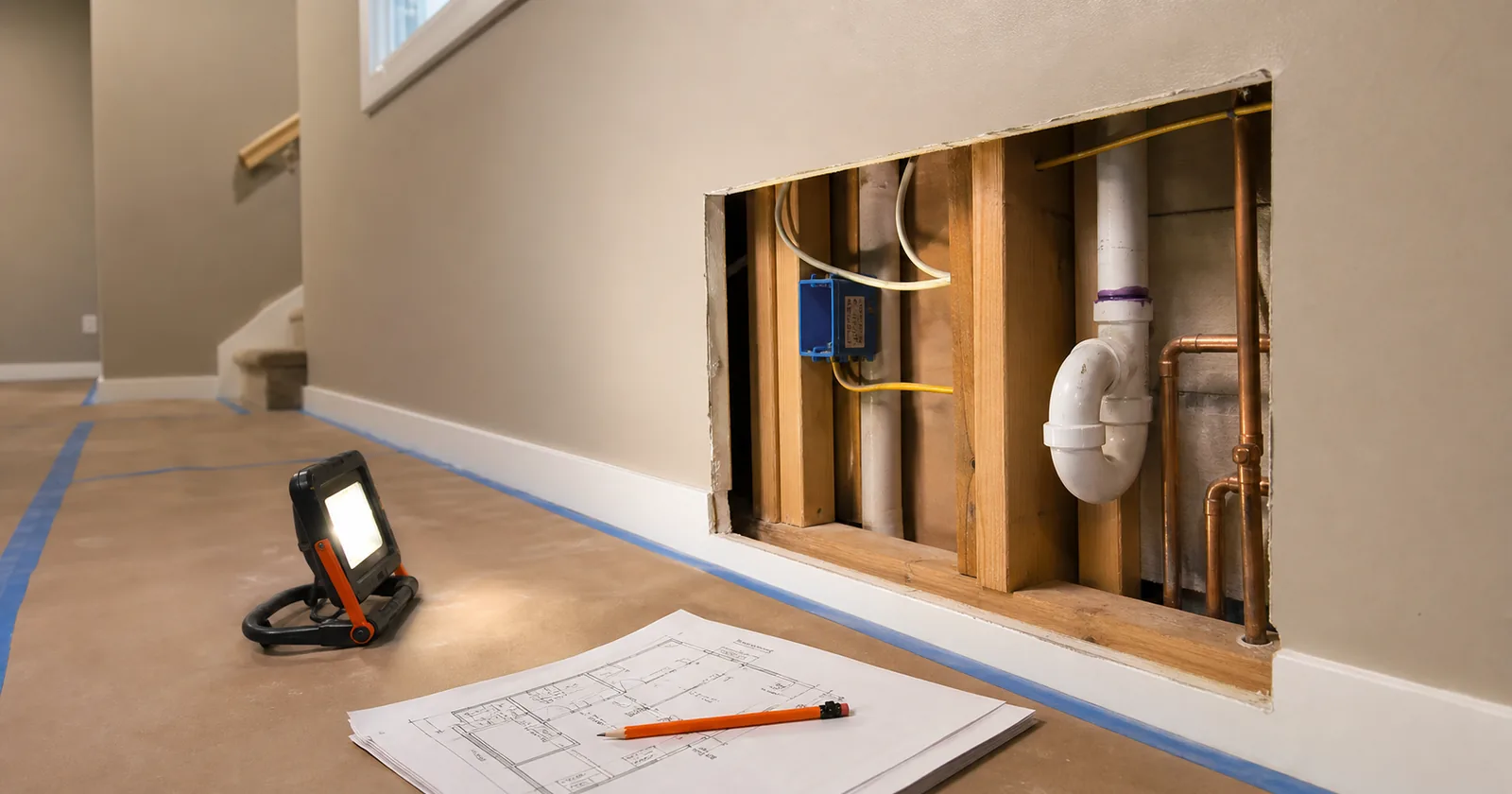
The appraiser has been in the basement eleven minutes. She measured the finished area, wrote down a rec room, a bedroom, and a full bath, then stopped at the electrical panel. There is a subpanel beside it, newer than everything on the wall. She photographs it.
Upstairs, the listing sheet says 2,400 finished square feet. The county record card says 1,750.
Nobody here did anything wrong. The basement was finished two owners back, and the sellers bought the house that way. The bath drains. The wiring may be flawless. None of that is the question about to get asked.
People misjudge the timing, not the odds. Discovery arrives on somebody else's calendar: an appraiser's, an adjuster's, a plan reviewer's. Every one is a worse moment than a Tuesday in February when you went looking on purpose.
Aging does not legalize anythingAging does not legalize anything
Folk wisdom says that if work stands long enough it becomes fine. It confuses two ideas.
Zoning does have a concept for old things that no longer comply. A nonconforming structure was lawfully established and later fell out of compliance when the ordinance changed around it. The whole doctrine hangs on lawfully. Work that never had a permit was never lawfully established, so there is nothing to protect.
Whether a village can still cite you ten years later varies, and that belongs with a local attorney. The record does not. Work built without a permit leaves a gap in a public file that half a dozen other processes read from, and those gaps do not expire.
The doors it comes throughThe doors it comes through
Discovery is a set of ordinary processes, each with a reason to pull your parcel.
| How it surfaces | What sets it off |
|---|---|
| Neighbor complaint | A dumpster, weeks of contractor trucks, a wall blocking their light |
| A permit for another project | Your application puts a reviewer on the parcel |
| Sale of the home | Appraisal measurement, the buyer's inspection, a records check |
| Aerial imagery | Change detection: a roof where there was grass |
| Assessor records | Permit filings feed valuation; field checks catch the rest |
| Utility or service work | A panel upgrade, a meter swap, a sewer repair |
| Insurance claim | An adjuster walks the structure, not only the damage |
The neighbor call is the fastest, and it is almost never about permits. Somebody is irritated about the saw at seven in the morning. Permit status is what the village looks up after the call, not what prompted it. The sale is the costliest, because a contract and closing date are already attached.
The permit you pull for something elseThe permit you pull for something else
This one surprises people most, because it is self-inflicted. You decide to do something correctly. A deck, a furnace, an egress window. You file. The application lands with a reviewer who opens the whole parcel.
That reviewer is not investigating you. They are establishing what exists so they can evaluate what you propose. But a finished lower level with no record, or a panel upgraded without an electrical permit, is now in front of somebody with authority.
As a permit technician I submitted more than 220 building permits documented well enough to account for. Thirty-seven closed as cancelled, and five of those were additional permit requirements surfacing mid-process. Not large numbers. Each of those five landed after the file was already open at the department.
The furnace still went in. What disappeared was the quiet option. Once a department asks in writing, saying you were unaware stops being available, at the counter and later on a disclosure form. Read up on basement finishing permits before the drywall goes up.
What a department can do once it knowsWhat a department can do once it knows
Enforcement is a sequence, and how far you travel depends on the work and where it sits.
A stop work order comes first if work is active. It gets posted at the site, and everything halts, including the portion that was properly permitted. Citations follow, and many jurisdictions add an investigation fee or a multiplied permit fee to an after-the-fact application. Amounts vary enough that any average would mislead.
Revocation is the piece people forget. An open permit can be pulled when the built work departs from the approved scope, and a converted space raises the certificate of occupancy question. Then comes the inspection problem, where the real money sits.
Where the work is compliant but unpermitted, the way out is an after-the-fact permit. That submittal is held to the same standard as any other, so the usual reasons a permit comes back with corrections apply to you too.
The money lands somewhere other than the fineThe money lands somewhere other than the fine
An appraiser describes a property as it legally exists, not as it is furnished. Finished area with no permit record usually gets excluded from the gross living area or footnoted about permit status. The bedroom is still down there. It stops counting.
That footnote is what the lender reads. An underwriter can condition the loan on the work being permitted, fund against a value that excludes it, or decline. Each lands on a closing date somebody already committed to. A cash buyer shrugs. A financed buyer cannot.
Insurance is the cruelest version, because the discovery and the loss are the same event. When an adjuster inspecting a fire or water loss finds the affected area was built without a permit, the coverage conversation changes shape, and it can end in a reduced payment or a denial.
Assessors read permits the same way. Cook County logged 106,495 permit records in 2025, each one a note that something was added and roughly what it was worth. The record you skipped is one several institutions expect to find.
Selling a house with it in the fileSelling a house with it in the file
Three moves exist, and the contract clock decides which are real. Pursue an after-the-fact permit, a fine answer with a year of runway and a poor one with a signed contract. Renegotiate and let the buyer take it on. Or remove the structure, the only option fully in their control.
Disclosure is where sellers get clever and regret it. All three states put a residential disclosure form in front of the seller, and each asks you to report what you know. A citation, an appraisal comment, or an email from the village is knowledge, and that exposure outlives the closing.
Go looking before the buyer's inspector does.
- Your parcel's full permit history, requested from the building department in writing
- A current plat of survey, in Illinois often already in your closing packet
- A written list of every improvement you know of, and roughly when
- Which items are placement questions and which are trade work behind a wall
- How the department's after-the-fact permit process works
A survey is often already in a folder at home, handed over at closing and filed without much thought. If not, residential boundary surveys are commonly quoted at $400 to $1,500, with Cook County more often $600 to $1,500.
Finding out on your own scheduleFinding out on your own schedule
Every route above shares one trait. Somebody else picked the timing every time, and their deadline was never yours.
The version where you pick the timing is unglamorous. Pull the permit history, find the survey, write down what you know, then ask the department the questions that decide everything else. People skip it because those calls are hard to make. Building departments are reachable only certain hours on certain days, and the one person who can answer is frequently not in. A requirement check ran about 20 minutes on a good day when I did this work, sometimes several days waiting for a callback.
That research is the part we take off you. We find what your jurisdiction requires to bring existing work onto the record, and whether the problem you have is a code question or a zoning question, which is the difference between fixable and not. Permitech is the permit intelligence ecosystem for construction, and a human permit technician confirms that answer before you take it to a buyer, a lender, or a closing table.
Unpermitted work is not a secret. It is a missing record, and missing records get noticed by the systems built to look for them. The only variable you control is whether you look first.